Interview: Sam Askey-Doran
Sam (Hobart, 2003) is a well-known triathlete from Tasmania, Australia, particularly recognized for breaking the swim course record at the 2024 Ironman World Championship in Kona, outperforming even the professional field. A former Australian national-level swimmer, he has developed into a strong triathlete, capable of winning overall age-group Ironman races and earning a bronze medal at the 2025 Ironman World Championship in Nice. Well connected within the professional triathlon and cycling community, he has built a tough, resilient mentality through years of training in the harsh Tasmanian winter, aiming to pursue a career in triathlon.
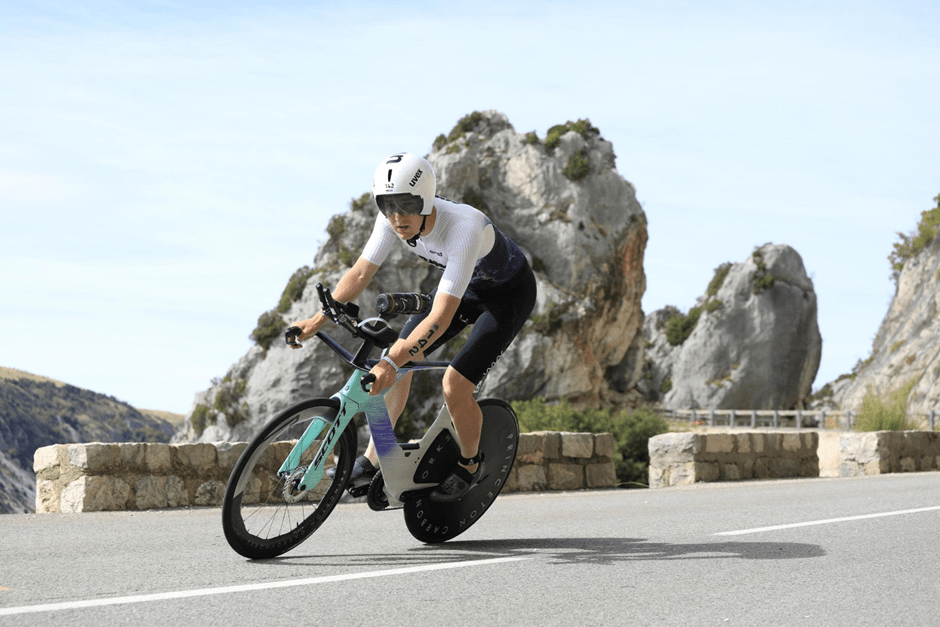
Sam racing at Ironman World Championships – Nice 2025
Sam, looking at your numbers… 3’59” in the 400m freestyle, 15’59” in the 1500m, 8th overall in Australia. You were a legitimate swimmer. What distances suited you most?
I always really liked the 400. You can split it up super easy – the first 100 meters never hurts, and after that you’ve only got 300 to go, so it’s pretty much just a sprint. But the distance that suited me best… I was one of those people that the longer the event gets, the better I perform relative to everyone else. I progressed from the 1500 to the 5k, then to the 10k, and the 10 kilometre open water races are really what I took to and focused on. The longer the better.
I wouldn’t mind trying to go for a 25k swim one day – a proper marathon. My swim coach used to do those, 25 to 30 kilometres. But out of everything I’ve already done, the 10k is definitely the distance that made the best of me.
Indeed, open water seems to have played a big role in your development. What did racing 10km events teach you that the pool never could?
In Australia, the open water racing is very physical. People always talk about how hectic the start of a triathlon is – but what a lot of people don’t realize is that the start of a triathlon is actually quite civilized compared to open water racing in Australia. Rather than teaching me any skills about swimming, it kind of taught me the attitude on how to race, which I think is super important.
Going into an open water race and learning how to race 10 kilometres against other people, changing different strokes, making tactical decisions, how to put together a race – that’s definitely something that open water has carried not only into my pool swimming but also into triathlon. It all translates: how to race on the bike, how to be aggressive, when to conserve, when to be patient, when to really have a crack.
Actually, you like to do “hard things” as your modus operandi in endurance training. Could you illustrate that with any example?
The 200x100m swim. That was insane. It was hard. That’s four hours and ten minutes of my life I’ll never get back. Two hundred rounds of 100 metre efforts, all on a 1:15 cycle, mostly around 1:08–1:09. At some point I had to yell at one of the lifeguards to fill up my bottle – just throw something out there: hey, can you fill this up?
In Australia it’s a tradition where squads do 100×100 at Christmas, so we thought: everyone already does a hundred, why not just double it? The original idea was to do 23×1000 to see out 2023, but my coach said that was probably too much. So we went with 200×100. A lot of people comment that there’s no point in doing something that long, but half the point is just putting yourself through something so outrageously hard that, when you get to scenarios that replicate that feeling later, you actually feel more comfortable. You know how you’re going to feel, you know how your body is going to react. You’ve done something so hard before that you’re comfortable doing it again.
That 200x100m session went sort of viral and even caught the attention of some professional athletes in your country. What happened after you posted it?
It sparked a chain reaction. Tasmania has some very good cyclists, so one of my good friends, Will Clark – who raced professionally for Trek-Segafredo and did stage races through Spain and Portugal – took a photo of that session and sent it to Richie Porte, who finished on the podium at the Tour de France. And then Richie forwarded that image to Cameron Wurf.
Cameron started following me on Strava. I already knew who he was – he’s a pretty important figure in triathlon. Lucky enough, he was actually in Hobart at the time, his first time back in five years, which was extremely good timing – just a matter of luck. I suggested he come and train with me in the pool, since swimming is his biggest weakness. And from that point, that 200×100 session led to Cameron and I becoming good friends, and him suggesting I do an Ironman…
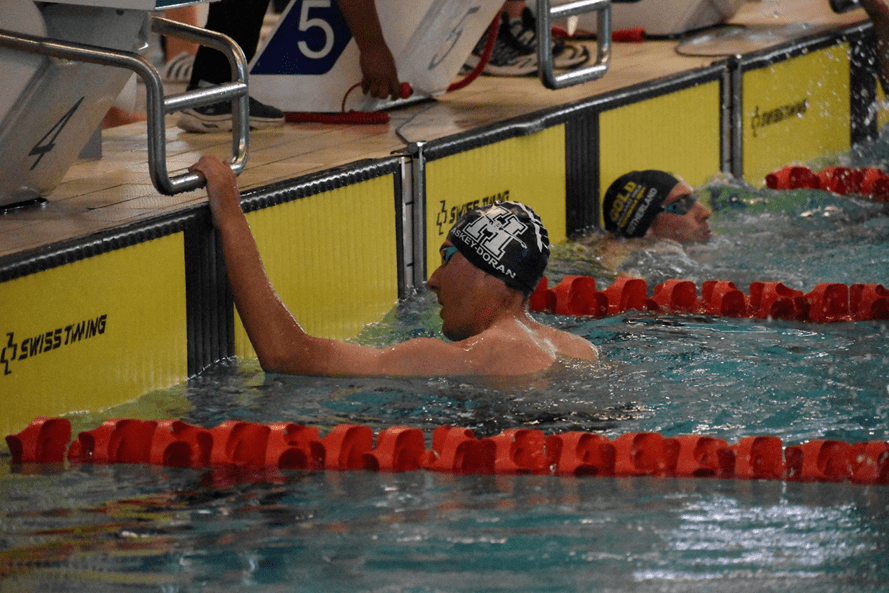
Sam competing at an Australian national swimming event
Looking back, before swimming took over, you were sailing at national championship level, which is remarkable as well. Is there any connection between the sports?
There is, if you look deep down. I started off sailing the small single-handed boats, progressed a bit, went to state championships, and as I got better and wanted to sail the bigger boats, my dad said I had to learn how to swim. At that stage I was maybe eight or nine, and I couldn’t swim to save myself. I failed my learn-to-swim certificate – I’ve still got it actually, a little printed piece of paper saying I shouldn’t be swimming.
Everything I’ve learned from sailing has helped me progress through open water. I actually swam an open water race the other day, and the only person who swam in a dead straight line across the river was me, simply because I’ve got that experience from sailing: seeing the current, what the wind’s doing, what different water shapes mean.
There was also a race about two years ago, a 1200 metre drag race along the coast. I managed to find this one small channel of water moving much faster than everyone else. While there was a pack of six guys swimming about 15 metres to my right, I was floating on my back and being carried along the beach by that current – not even swimming – and moving faster than those guys, who were actually swimming.
There was a coach back in 2020 who told you that you were “not worth coaching” and wouldn’t make it in any sport you chose to do. What happened in that conversation, and how did those words sit with you?
It was definitely a confronting conversation. 2020 was the COVID year for us in Australia – the pools shut down, and instead of swimming I was riding my mountain bike. When the pools opened back up, I got back in and I just wasn’t enjoying it. I was in this middle ground of wanting to be good at something, but not wanting that something to be swimming. There was a lot of tension between my coach and I, a real clash of heads. It snowballed into almost like an argument about who was right and who was wrong, turned quite aggressive on both sides. It’s something that shouldn’t happen, but it was a conversation that probably needed to happen.
After that, I left the pool and never went back to that same pool since. I took two weeks off – just doing whatever I wanted. Maybe jumping in the pool for an hour on my lunch break from school, that was it. Then I got in contact with another coach here in Hobart, did four weeks of training with them, and dropped nine seconds off my 400m time.
So I went from being at an all-time low, really not enjoying any sport, to going from “here” to “up here”. That whole experience taught me that change is actually a good thing – you reassess, set some goals, change the environment you’re in, and all of a sudden you get back on top of the world again.
Then you discovered triathlon by being the swimmer in triathlon relays… First Ironman ever: Cairns 2024. You go 9:01, finish 2nd in your age group and qualify for Kona WC. Were you surprised, or did you know you had that in you?
I was definitely surprised. We were out on a bike ride and I asked Cameron: do you think I should do a half or should I do a full? And Wurf is like, ah, just do the full. So we signed up for Cairns. I was 100% unprepared – had no idea what I was doing. All my running leading into it was just easy runs, an hour at a time, because I just hated running. Being a swimmer, I was never good at it.
I got the bike, got the kit, got all set up, and went in with no expectations. I just knew I wanted to swim faster than anyone else, which I did. And then I pretty much rode the bike blind – not looking at power or time, just by feel.
To this day, the only screen I have on my computer is the map, with the live elevation profile for the next kilometre, my cadence, and my speed. No power, no heart rate, nothing. I don’t even know how far I’ve gone on the bike… I raced my first Ironman that way and it’s just always been that way since.
You’d only been cycling and running seriously for a short time before that first Ironman in Cairns. As a beginner in those disciplines, did you struggle at all in your first steps into triathlon?
I’d been running for about six months and riding properly for about a year and a half. Honestly, with the support network I had between Wurf, Richie Porte, and a few other guys I know through different networks, it actually all came quite easily.
Training with Nathan Earle – a cyclist down here who rode for JCL-Team Ukyo, did a stint with Team Sky, and trained with Richie Porte and Chris Froome – you go out for a three-hour ride and get 80 kilometres with two and a half thousand metres of climbing. That certainly accelerates things.
The hardest part was staying away from the pool. When I first came into triathlon, I’d swim in the morning, work from nine to two, go for a run, look at my watch and think: it’s only four o’clock, swimming training starts at five, I’ll just go to the pool. You’re in such a routine that you just kind of end up there anyway. It’s like you’re in a trance. You run, and all of a sudden you wake up at the pool and say, how did I get here?
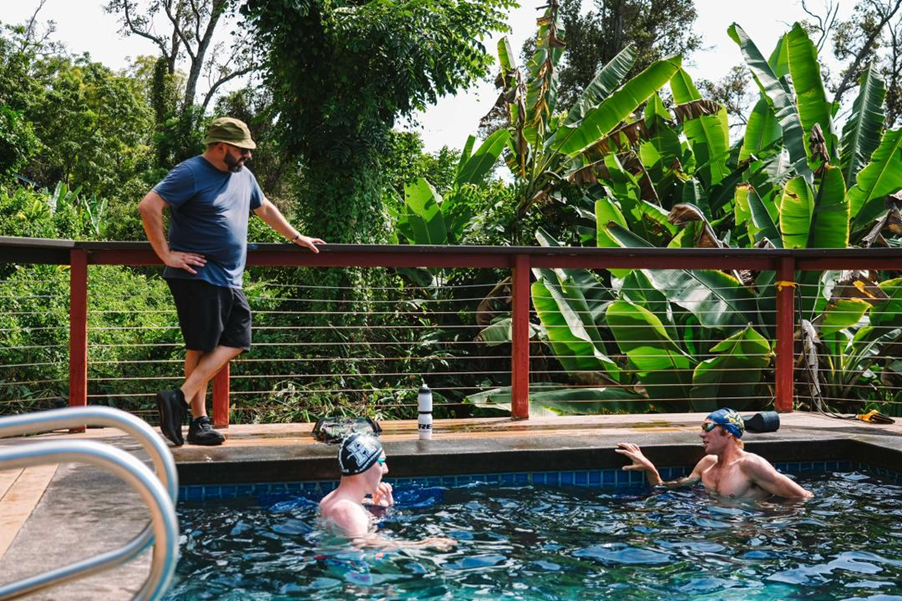
Final strokes and talks with Cam Wurf before Sam’s Kona IM WC debut (2024)
Kona 2024 was your first Ironman World Championship and, for many people, the race that put your name on the map. You swam 45’43” and set the Ironman World Championship swim course record, including the pros. Did you expect that? Or did you go for it as a clear goal, like Jan Sibbersen, the previous record holder?
Pretty much the whole idea of me going to Kona came from Cameron. He literally said: do an Ironman, qualify for Kona, break the swim course record. It was his idea. So we went there with that goal, but there was a part of me that wasn’t able to put 100% into that swim – it just didn’t sit well with me. I wanted a good swim, but I also still wanted to do well overall. A lot of people find this strange, but it was actually a really bad swim on my behalf. I’m not proud of it.
About a month or two before Hawaii I had done some 4k time trial sessions in the pool and I was swimming in 44 minutes flat. That’s 200 metres further than 3.8k and a minute and a half faster than what I did in Hawaii. I’m proud of having the record, but I’m not proud of the time.
Cameron was telling my only job on race day was to swim fast – and that’s it. I was like, yeah, but Cameron, there’s a marathon to run afterwards… and that’s Kona, especially. I don’t think I went all out for the swim record but at the same time I certainly swam over Ironman effort for it. And I kind of hurt myself a little on the bike as a result. I really struggled the last 20 kilometres. But yeah, it’s all learning.
You’re used to being first out of the water… And chasing isn’t the same as being chased, and overtaken. How do you manage that within the race? What goes through your mind in those moments?
In non-world championship ironman races it’s actually quite easy, because I just try to catch up to the pro men. In Cairns 2025 I positioned myself at the front of the swim trying to catch as many female professionals as possible, then got on the bike and started chasing the professional men – which I actually did. I overtook eight or nine of them on the bike, plus a few more in the swim.
But in world-championship races, once I get on the run, I turn into the hunted, and that’s a very scary feeling because I’m moving a lot slower than some of the other competitors. When you’re being hunted it’s easy to start riding to stay away rather than riding to improve your lead. You start overworking, stressing over small things. On the run you’re always checking your watch, asking people for splits, doing a lot of maths to work out if you’re safe.
I actually caught up to Matt Hanson, the American pro, on the bike in Nice WC last year and overtook him on the descent with about 30k left. Then out of T2 I had a few hundred metres by myself and was running around 4:15 per kilometre. Matt came up alongside me and we were talking back and forth – he’s a good friend. I looked at my watch: I was running 3:30. My first kilometre started at 4:15, then 3:50, 3:45, 3:35. Running next to him I just sped up without realising, and I thought oh… I’ve gone too hard. It was interesting.
What many people may not know is that you’re also a very strong cyclist. A 4h40 bike split at Kona 2024 speaks for itself… How is that affecting your training balance? Since your swimming is almost “a given”, do you focus less on it and try to leverage your running instead?
I come from a strong swimming background where I was training 13 or 14 times a week just for swimming, and I’ve dropped that down to five swims a week now, what is nearly a third. The riding has come up quite a bit. Before that WC in Nice I got nearly 20 hours of just riding in one week, on top of everything else.
The running is my biggest weakness and my coach has been really pushing it. From the start of this year we built the mileage up by five kilometres each week, getting to around 80–85 kilometres of running per week. The swimming always just stays the same. It’s constant balancing – sometimes it’ll shift to intensity on the bike and volume on the run, or just volume on the bike with intensity on the run.
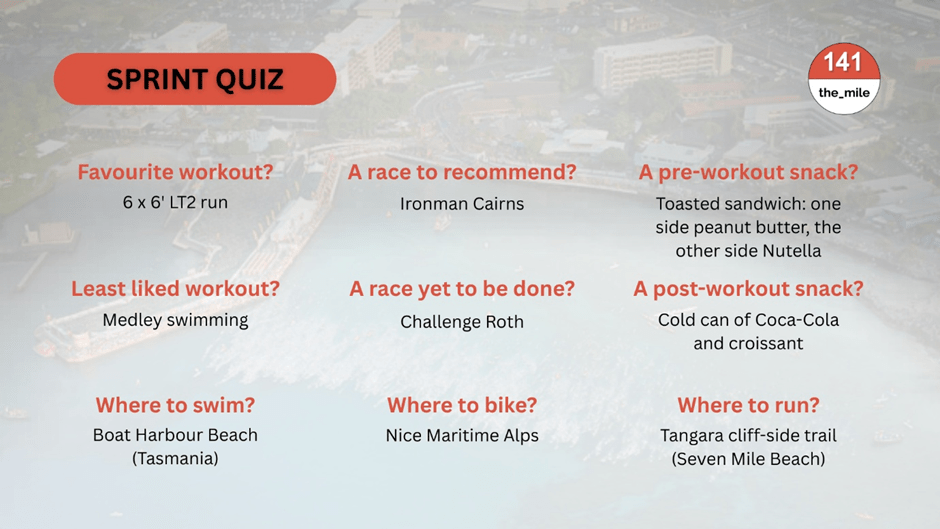
Sprint Quiz to Sam Askey-Doran
To be a good swimmer you need to master technique. From your experience, what typical mistakes do you see in other triathletes who don’t come from a swimming background?
There’s a common misconception that because you’re saving your legs for the bike and run, you don’t need to kick. But the kick provides stability and propulsion – it brings the hips up in the water and all of a sudden you’re so much faster because you’re not slowing yourself down. If you get good at the kick, you’ve got free propulsion you don’t even have to work for. When I’m kicking with a kickboard I can do 100 metres on 1:35 super easily. In a race your legs are barely working, but because they’re so conditioned, it’s just active propulsion the whole way.
The other big one is that a lot of triathletes actually look forward when they’re swimming rather than tucking their head down. There’s a difference between sighting – lifting your head to see where you’re going – and just permanently looking forward, which drops the hips entirely. That’s super easy to fix but not many triathletes get pulled up on it. You see it especially in open water when people are looking for feet or trying to see what’s in front of them, when really it’s just faster to keep your head down.
And what other tips would you give to weaker-swimming triathletes so they could really focus on what matters to make tangible improvements?
Consistency in the water. A lot of triathletes swim once or twice a week, and with that you’re essentially starting from scratch each session. I’d actually suggest cutting your time in the water by half but doing it twice as much. If you were swimming an hour on Tuesday and an hour on Thursday, try 40 minutes on Monday, Wednesday, and Friday, maybe a fourth session on Sunday. You get that active feeling in the water much more regularly and it helps a lot more than fewer, longer sessions.
And don’t just swim easy. You can do some higher intensity efforts – it doesn’t have to be long. A few rounds of 6×50 metre efforts with good rest, 20 to 30 seconds at the wall, is enough to bring up your top-end speed, which makes your low-end speed feel much more comfortable. Consistency plus a bit of intensity – those two things would make a tangible difference for most triathletes.
Back to your progression: at Ironman Cairns 2025 you won age group overall in 8h45, a 16-minute improvement from a year earlier. Then Nice 2025, World Championship and 3rd in your age group. Compared to your first triathlon, how do you see yourself as a triathlete today?
In my first triathlon, a lot of people – and myself too, honestly – saw me as a swimmer who rides and runs for fun. Actually at the beginning of 2024 I was a national level swimmer. That was my identity going in.
I’d think: I’m just a swimmer, nothing special here, no expectations. Then you go to Kona and it’s the same deal – everyone saying he’s just a swimmer, yeah he got the swim course record but he’s just a swimmer. Even on Instagram after I got the record, people were like: he swam well, but he’ll probably turn in the slowest bike and run splits…
Now I’m starting to become more of a complete athlete. It’s a big change in identity knowing that I’m a completely different athlete than I was a year and a half ago. I know there’s still a long way to go, and still a lot more left in the tank. But from my first triathlon to now, I feel more complete, being someone who is competitive.
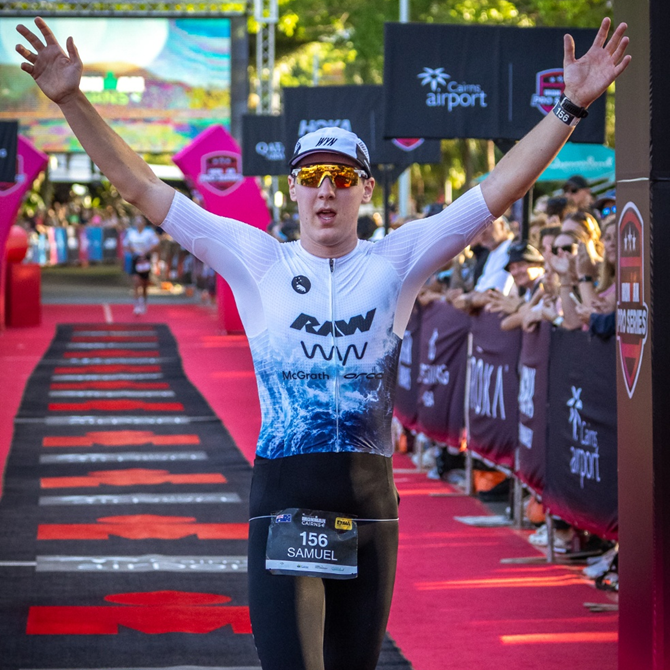
Overall age-group win at Ironman Cairns 2025
What’s left to prove as an age-grouper? Are you thinking about turning pro, setting other goals still within the age-group categories or even exploring other sports?
The immediate goal is to win Ironman New Zealand. Last year I was leading from the swim – got the swim course record by three minutes, was first off the bike, had a 35-minute lead on the next closest person in T2. And I lost it. I got caught with 1.5k left on the marathon. That was such a hard day. I left so much out there.
I told myself I wouldn’t let myself go and race professionally until I’ve won my age group at a World Championship. I came close in Nice – missed winning by three minutes. I had 25 minutes on the next closest person in T2 and got caught with about three kilometres left. But I also spent three minutes on the side of the road fixing a mechanical at the bottom of a descent, so it’s hand in hand.
I would like to make a career out of triathlon. But either way, the plan is still the same: win an age group world championship first, simply because I need to prove to everyone else and to myself that I deserve to be racing the pros. There’s no point going professional if I’m just going to get dropped off the back with 50k left on the bike. I want to be at least a competitive person in any race I enter.
With all these achievements, especially your widely talked-about swim course record in Kona, how has this affected your visibility within the triathlon community or in your country? Does it add any extra pressure to your goals?
It does a little bit. Having that record means everyone always expects me to swim fast, but now that I’m focusing on the race as a whole, I don’t actually want to swim fast – I’d prefer the swim to be easy.
Everyone sends messages asking how fast I’m going to swim or whether I can beat this person, and at the end of the day I just want a good race. In Australia a lot of people only know me for that swim, which is fine – any publicity is good publicity. It’s certainly helped attract sponsors. You can guarantee people you’re going to be first out of the water and all of a sudden they want their products with you. Raw nutrition came directly after Kona, for instance.
In Australia there aren’t many people in triathlon who don’t know me now. At the race village in Nice people were coming up: “are you Askey-Doran? You got the swim course record in Kona!” And in Ironman New Zealand last year. I was really struggling on the run with one lap to go, and I hear this guy in a Kiwi accent: “dude, are you Askey-Doran? I couldn’t swim before, but I saw you race and I wanted to learn how to swim so I could be more like you”. That meant absolutely everything to me. To have someone change the way they live because they were inspired by you – it’s just the greatest news ever.
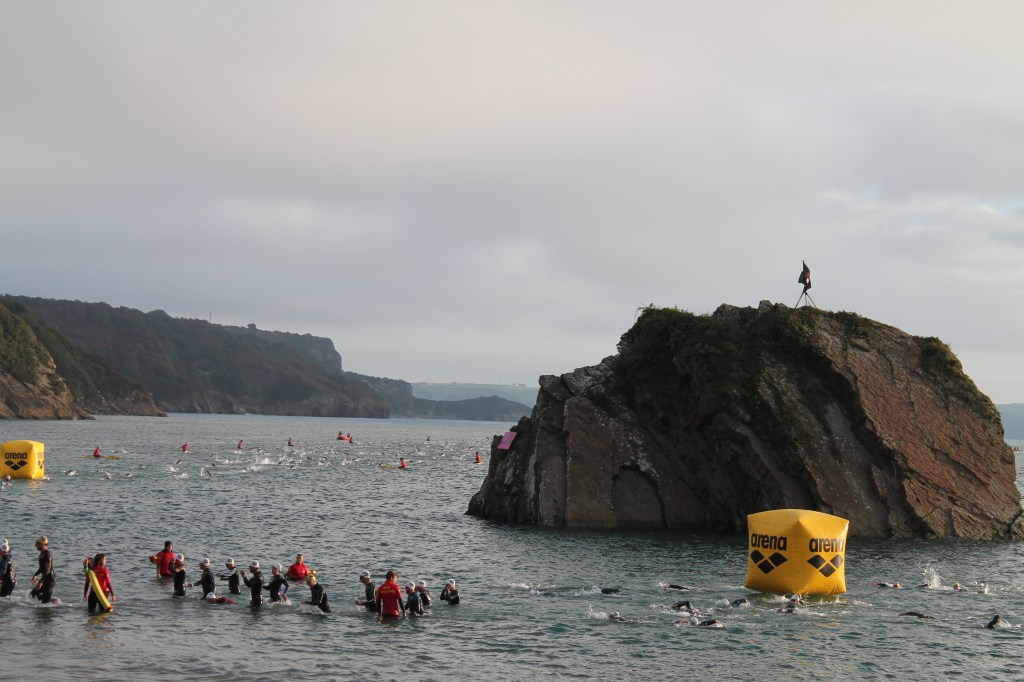
Training through a Tasmanian winter doesn’t seem to be an easy thing. What challenges do you face in your day-to-day training?
It’s hard to describe, but it makes you a very tough athlete. Our weather changes so quickly… just yesterday, this being summer for us, I did an open water swim in the morning in perfect conditions, got on the bike and after 15 minutes into the ride it didn’t stop raining for the next two hours. I was in summer kit, it was eight degrees, and I had to get my mum to pick me up. The forecast said that much rain and I got that much.
Through winter, besides running after 5pm, when it is pitch black outside, the challenges are always on the bike. Ice on the roads, snow, constant rain, usually anywhere between five and minus five degrees. I’ve done four or five-hour rides where the average temperature is minus one – usually when I’m trying to train for Hawaii, which is a hot race. Most of my crashes have been in winter on wet roads. But I always prefer riding outdoors – the only time I go indoors is for specific efforts like three by 20 minutes at 400 watts or something like that, because it’s just too hard to do outside and get it right with the roads. I’ve been out riding in snow, in rain, in crazy wind. I’d much rather that than the trainer.
You work in a bike shop, and they’ve structured your hours around your training. That is quite special and supportive. How crucial has your job’s flexibility been in keeping the whole thing sustainable?
It’s been a great help. The bike shop I work at has quite a few athletes there – myself and two or three cyclists all going across the world to train and race. My boss has been super cooperative with both organising time off for racing and working everything around my training. My Training Peaks days off are set into the calendar, I’ve got set hours that work for both training and work, and they support me with anything I need – they helped me get my new triathlon bike, my road bike, and take care of all parts, labour, and servicing. Next week my bike goes in to get a full service: new bottom bracket, new cranks, new drivetrain, the whole works.
That being said, it’s not a long-term job. A professional triathlon career can only last so long – I can’t still be racing Ironman and be as fast at 60 years old. I did attempt university, studying psychology, but I didn’t enjoy the degree I was doing, and the university itself was absolutely terrible administratively. I definitely think some level of higher education is super beneficial, and there needs to be something more permanent further down the track. But at 22, working in a bike shop is very, very doable.
Next interview:
To be confirmed
 the141mile.com
Leave a comment