Interview: Manuel Cruces Prado (Marqués de Panoramix)
Entrevista en Castellano aquí
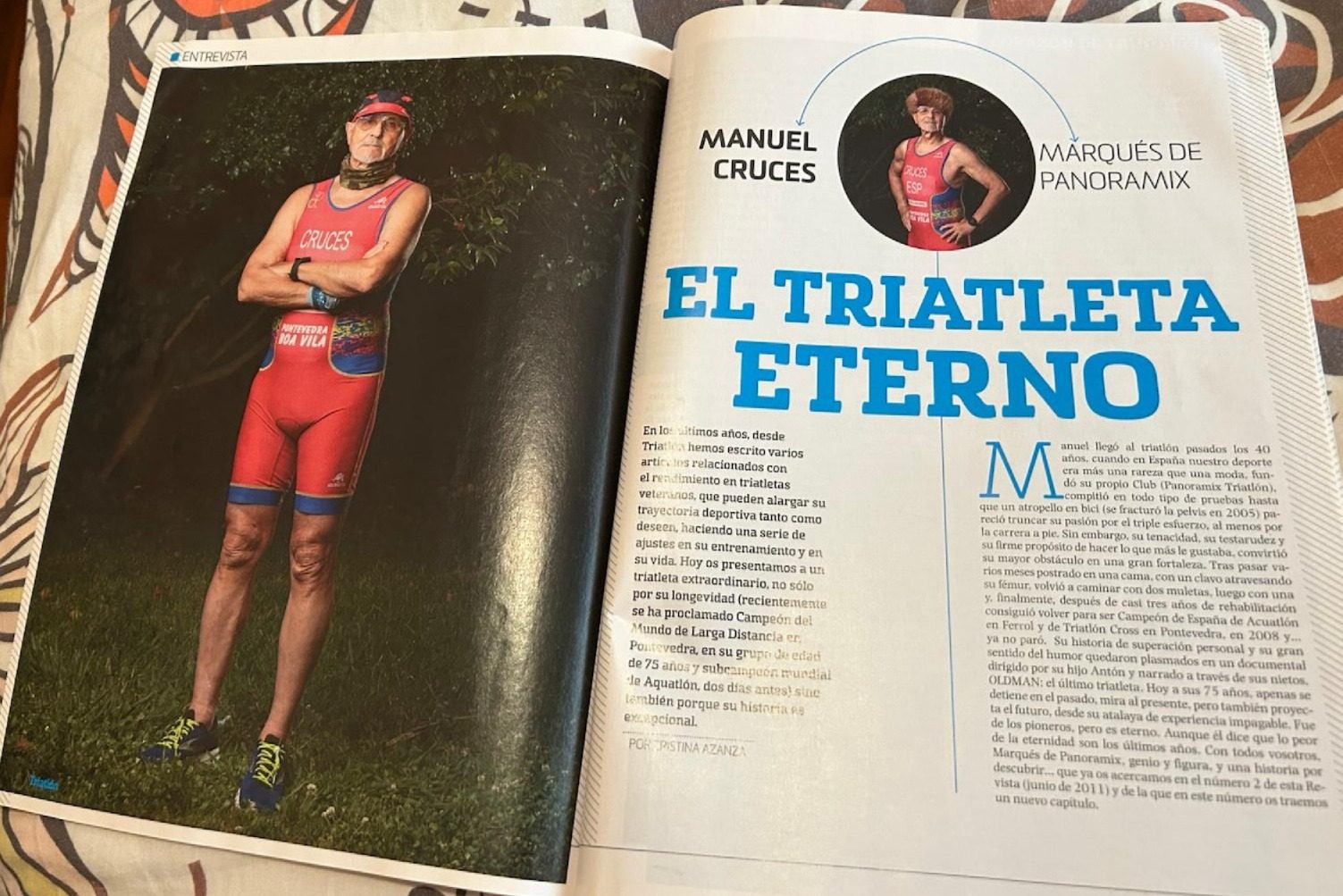
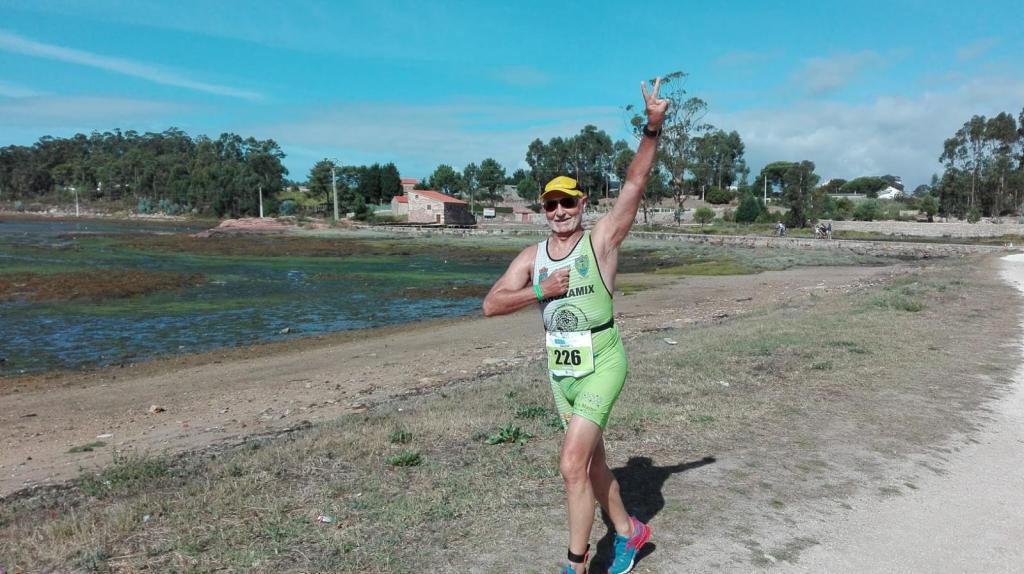
Born in Curtis, A Coruña (Spain), on 1st of January of 1944, he is one of the most veteran triathletes in the country. Dermatologist by profession, he started in triathlon at late age. Since then, he has won multiple regional, national and international medals in different triathlon distances. The pinnacle, the Long Distance World Championship in 2019 at the age of 75, in Pontevedra, where he lives. Very well known within the Spanish triathlon community, not only due to his achievements but also because he is quite the character!, and has his own film: “Oldman”!
You have not been in triathlon your whole life, but you have been in it for a lifetime. At what age did you start, and which were the motivations for it?
The first triathlon I did was in the Algarve region, the Don Pedro triathlon, in July 1990, when I was 48 years old. And the typical thing… you go out full speed and after 25 meters of swimming, you are breathless. I thought I drowned.
There was one triathlete who always beat me, but I did not even know who he was. I remember him wearing a black trisuit at the Barcelona triathlon, when Montjuic climb was part of the course. When I was in the first lap of the bike, he was already coming down the second lap, like a blast. That guy was called Iván Raña, 18 or 19 years old.
You have also practiced other sports, right? What attracted you most from triathlon to take it more seriously?
I had played roller hockey seriously, I mean, federated, in Deportivo de A Coruña team. We played in María Pita Square. It is a very complete sport, but I was very bad at it because I did not have very good control of the roller skates, and there were guys who skated much better than me. Once we lost against Espanyol de Barcelona 16-1, and I scored the penalty, I remember it perfectly. Nowadays, there are roller hockey world champion players in A Coruña.
Later, before starting in triathlon, I started with clay pigeon shooting. It is a very tough sport, against what people may think. I have cried out of rage and helplessness in some triathlon competitions, but in shooting, I almost always cried because I did not have enough concentration to make it to the finals. The pressure got to me. Once, at a World Championship, leading the score together with other competitors, I lost focus and scored three zeros in a row. And that was the day I came home, put the shotgun away, and never shot again. And that was 50 years ago. Guns are for sale, if anyone is interested…
I also participated in lifeguarding, and we went to the Spanish Championships. We even finished runner-up. There were three or four very demanding physical activities.
Triathlon has also a connection with my younger days. I used to swim alone across the port of A Coruña every afternoon and “play” at getting between the boats and the “tarrafas” of the fishermen who came to fish sardines.
I used to go swimming on a bicycle I had hidden in a table-football club, since my parents would not let me ride a bike because they said it was too dangerous, that there were too many cars… back in the 1960s! And in A Coruña there were “six cars”… Instead, my mother gave me tobacco to smoke because it was for boys. Can you imagine the concept?!
In the end, when I later started in triathlon, since there was practically no one else around, I did it pretty well. And all things considered, I did not feel pressure because I was just going to have fun. Half of the races I won in my age group I did not even realize I had won until I reached the finish line.
What triathlon teams have you been part of? Actually, you even created your own team, right?
Here in Galicia, I do not think I belonged to any team other than mine. Since there was not one in Pontevedra at the time, I founded my own, the Panoramix team. I was the president, though it was run by a “kid” who had been a student of mine at the Faculty of Medicine and later became a sports doctor. Dr. García Soidán is nowadays a Sports Physiology professor.
Panoramix is your nickname. Why do they call you that, or why do you call yourself that?
It dates back to when I used to do pigeon shooting, which is now banned, in A Toxa (La Toja). There were three shooting ranges and loudspeakers. During the competitions, the entire facility would hear a paraphernalia like this: “Shoot so-and-so, Prepare so-and-so, and Ready so-and-so.” And people there were all nobles… counts, dukes, and the like. Since I was there to have a good time and did not care much about the competitions, I called myself Marqués de Panoramix, which supposedly came from an uncle of mine who was from Brittany…
Carlos Poyán, Conde de Torres (Count of Torres), who was from Pontevedra, was the only one who knew that my name was invented, and that bothered him… “Shoot Conde de Teba, Prepare Conde de Torres, Ready Marqués de Panoramix”
But the story of the name goes way back, to when I used to go clay pigeon shooting in Santiago de Compostela. There, one of the shooters was a huge, obese guy, who was called Obélix. And there was another one, who was my cousin, who called himself Astérix. And I said, okay, well, my name then is Panoramix.
Swimming is probably your best sport. In fact, you have done many open water competitions. What does open water give you that you love so much?
Yes, I have done many. The longest were Cíes-Bayona (16 km) and Cíes-Sanxenxo (13 km). Many were 10 km long, like Cíes-Vigo.
The one I like most is Sisargas-Malpica. It is a “short” route (around 4500 m), although by suggestion of me and others, it has also been done as a round trip (9000 m). It is a crossing where, if the sea is rough, you really have to swim. It is also the one with the most chances to spot marine life. I have occasionally seen dolphins surfing nearby and others passing below, although you barely see these.
On these swim crossings I usually arrive quite late because I always separate myself from the group; I call it “swimming at altitude”. I never follow other feet; I want to go “with calm, on my own”. I typically get accompanied by someone in a kayak or similar to keep an eye on me, partly because of my atrial fibrillation and partly because of my irritable bowel syndrome. Swallowing air and seawater, after all, is purgative, and gives me very painful cramps.
What do open water swims give to me? In our waters, cold, especially…
It would take too long to explain, but to simplify it: they integrate me into the cosmos, they make you part of the universe and feel very small and humble. At the same time, you assert oneself and talk to yourself. You do not want the swim to end, and when you see land, the feeling is both sadness and relief because even though you could not do much more, you feel sad that it is over. I do not know if I am making myself clear.
You have participated in all kind of events in many different places, but you have never “officially” completed the iconic Ironman distance. Has it never really appealed to you?
I participated in Ironman Vitoria-Gasteiz 2019 but I missed an intermediate cut-off time in the bike leg (by 80 seconds). Still, I finished the bike and the run… without the bib number.
They set cut-off times for +60 triathletes, but of course, ten or fifteen years older is not the same.
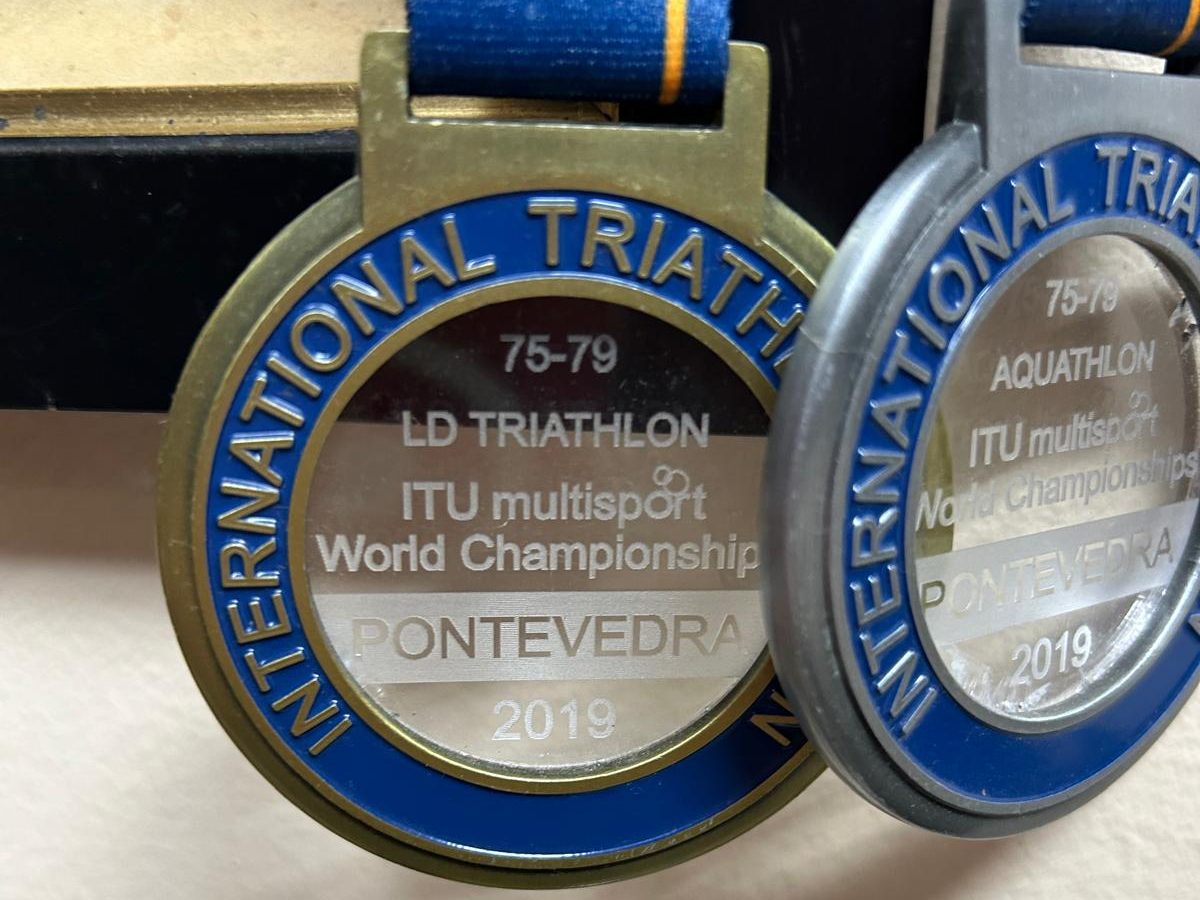
The longest competition I have “officially” finished was the Long Distance World Championships in Pontevedra in 2019 (3k-113k-33k, although shortened to a 1.5k swim because the water was at 11ºC, although officially 13ºC). I did quite well, finishing ahead of the second-place finisher. It was close to 10 hours, I think… But never again! I was 75 years old, and at that tender age, recovery is very complicated and long.
Ironman is for very long-suffering and brave people.
As an anecdote, I have the first finisher’s T-shirt from the first Lanzarote Ironman, in 1992, where not many people started. Kenneth Gasque, the organizer, gave me the shirt because I was there, even though I did not sign up. After the race, he told me he gave it to me because he knew “you could do it”. But I did not consider myself ready.
Do you have any thorns in your side? Whether it is to “officially” finish an Ironman race or any other event.
I must not have a thorn in my side because I do not remember.
I could not finish the race because, a few days earlier, while rafting on the Pacuare River, I was swept away by the current and suffered a tremendous blow to my quadriceps. I was able to pedal, but not to run. Due to both the pain and the howler monkeys that kept me awake during the night, I was only able to complete the swim (interesting because of the piranhas, although finally there were no piranhas at all). When I got off the bike, a lot of ice and two days in bed in a hotel in San José.
Another sort of “thorn in my side” is not being able to participate in the first crossing swim of A Coruña, from Orzán Beach, going around the Hercules Tower, to the Náutico.
Being kind of a pioneer in the sport, you have met many world-class triathletes. Do you have any interesting anecdote with any of them?
I raced with a lot of world-famous triathletes, of course, but they were kids and I was an age-grouper.
I remember Jan Frodeno, in a triathlon in Pontevedra. He got a flat tire as he was heading to the transition area, from the parking lot at Barcelos Square, about 400 meters away. I helped him with the puncture, and I think I even gave him a tire… He was a tall kid.
I also remember Dina Bilbao, who was a Spanish champion. One of the first triathletes and adventurers. She disappeared in a shipwreck in the Caribbean.
Another one who ran with me was Marisol Casado, former president of the ITU and now at the IOC.
Iñaki Arenal, the Spanish national team coach, used to run in the senior championships in my times, with his arch-rival Paco Godoy (Anna Godoy’s father). I remember we were all taking bath in a fountain (that is how it was) at the Rábade triathlon, and I already had a Polar device. Iñaki asked me what that watch was… He later represented Polar for many years.
Saleta Castro started with a bike I gave her, and I introduced her to triathlons. She was 13 years old.
Galician long-distance world champions such as Javier Gómez Noya, Pablo Dapena, Iván Raña… Some of them call me “master”, as a joke, though meaning it.
And I do not know what else…
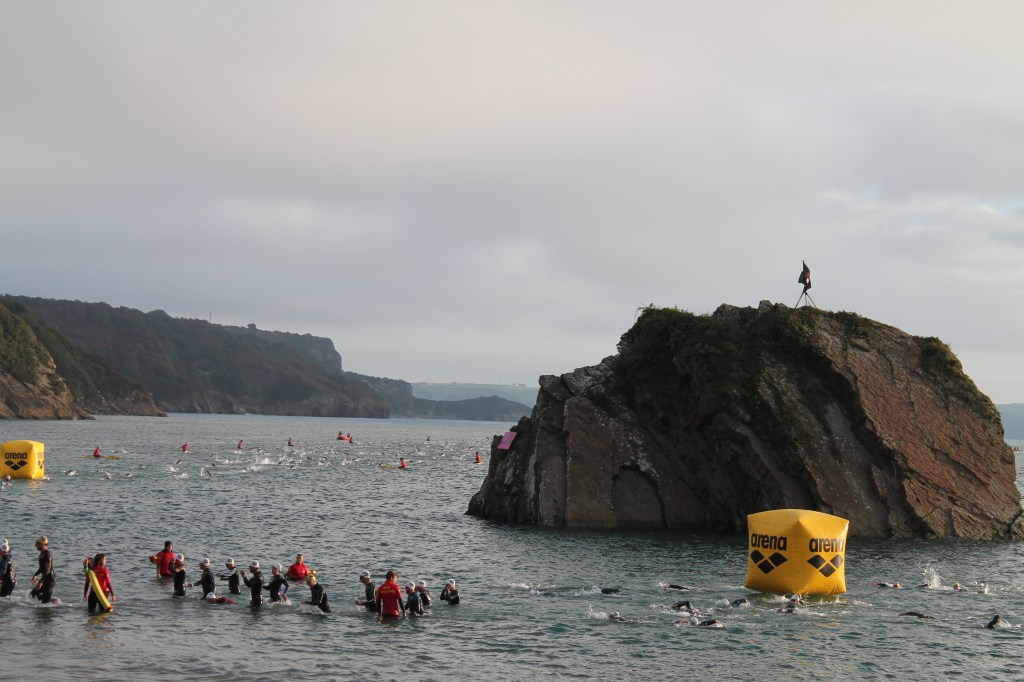
I was hit from behind by a car (“but it was unintentional,” the woman told me). Three years out of work. Pelvic fracture.
First, I was in bed for 58 days with a nail pulling on my femur; in fact, one of the most wonderful feelings of my life was being able to sit down and talk with the WC again. Then, I was in a wheelchair for months. Then, I was on crutches for months. Then, I was on one crutch for more months. Then, I had a wedge on one foot for years and underwent all the pertinent rehabilitation.
It was very difficult due to the many architectural barriers there are in cities for people with disabilities. Getting onto a sidewalk with crutches is almost like finishing a triathlon.
You returned to competition in a 70.3 in Monaco, which you remember well, but for other reasons…
After the accident, my “re-debut” was at Ironman 70.3 in Monaco, climbing La Turbie and the Alpes-Maritimes. I finished the last one… Before that, the helicopters were already looking for me, because I had to talk to my irritable bowel in the weeds several times. They had already opened the course to traffic… but I made it. It took me 7 hours, 33 minutes and 24 seconds.
After that, I did more, but my hip was still broken, and running was difficult. This was 2009. In 2019, I won the Long Distance World Championships… dying of pain on my leg.
You have certainly had quite some problems with injuries in recent years, but you have managed to keep moving forward. Were you always clear you wanted to continue in the sport?
Injuries do not typically prevent you from keep training… You can almost always “swim” one of the sports, even if it is not at the same intensity. Swimming mainly, cycling as well. Perhaps running is the one you usually cannot do. And as soon as you recover, you go back to triathlon, and in the meantime, you participate in other disciplines.
The point is that you can participate almost anytime, you can compete sometimes, and you can contest only a few times because “form” lasts for a limited time. And you shall always enjoy it, even if it hurts.
Yes, perhaps that week of LD Triathlon World Champion and Aquathlon runner-up two days before (I saved a lot) was my best event.
I had already been LD World Championship runner-up in Vitoria in 2012, within 65-69 age group.
Which is the race where you have struggled the most? Whether because it was difficult, you were not having a good day, etc.
The triathlon I suffered the most in was the Alpenhaus. It is incredibly tough. I was not feeling well, but I finished it by a miracle.
Due to both the climbs and the descents. I went upfront to recognize the circuit and what stood the most out were the mattresses. Yes, the mattresses. They had them hugging the trees on the turns, in case you hit one… Very hard.
I went twice.
Thirty-five years collecting treasures from all your competitions. Which three would you bring with you to the (uninhabited) Tambo Island?
Maybe the medal for winning the Lanzarote Volcano triathlon, the World Championships medals… and a caldeirada de rape (monkfish stew).
What period have you enjoyed the most in all these years?
Then you overtrain and the known injuries turn up… (just ask González Amo). You have to reach race day “full of energy”. According to Marqués formulas:
F+H=Podium
F+H+B+L=Champion
(T for training, R for rest, F for form, H for hope, B for brain, L for luck)
Actually, I think I have only been to very few competitions without any problems… Your bike not arriving on the plane (three times), your helmet strap breaking (from then on I never leave it the day before), your tires flat, two cycling shoes from the same foot! or your running shoes, your wetsuit opening, your swimming goggles (they politely “remove” them from you at a buoy), stomach issues from eve dinner, you cannot see the course well and you get lost (I am a specialist in that), or in the running leg, and sometimes even when swimming; they explain it wrong or you do not understand it well and you miss a buoy… All of that happened to me.
More than three decades allow for a lot of progress in any aspect of life. What has been gained and lost in triathlon over all this time?
Triathlon has lost its essence by becoming “Olympic”, with drafting; that is a different sport.
When we started, it was a “fight” between a few “crazy” guys against a distance. We did not compete against each other; we wanted to enjoy the “trip”. Just finishing was enough. We helped each other with food, drinks, and even breakdowns. Of course, you always liked to rank well, but winning was the least of it. Only one person wins.
When the Olympic “circus” and shorter distances for TV began, another sport was started.
Now that you can look back and evaluate your entire journey, would you really take a similar path again, or would you have tried something else?
I do not know. It is very difficult to predict… especially the future.
When you do long distances, especially swimming, you have a lot of time to think and sort your world out by talking to yourself… (sometimes I need advice from experienced people). It is hard to find that in other sports.
Have you learned anything from triathlon useful for your career as a dermatologist?
Yes. In my specialty as a dermatologist, triathlon taught me the patience required to take clinical histories from complicated patients and clarify certain dermatoses, because they are often overtreated. Everyone feels “qualified” to apply creams and ointments.
A dermatologist is a specialist; imagine a cyclist, for example. But in triathlon, you have to do all three disciplines, just as a skin doctor has to view the patient as a sick person, not just someone with a skin sore. In fact, the skin is the largest organ in the body and has a highly variable capacity for expression that only a dermatologist should interpret. Not sure if I am making myself clear.
To finish, I would like to thank all the many people that have helped me during all this time, especially to my partners, who when the thing got hard were always there.
Next interview:
Mario André Rocha (Portugal)
 the141mile.com
Leave a comment